Touching greatness
Poland’s most famous export, The Witcher is a fantasy series that centres on the exploits of one Geralt of Rivia. Twisted into a superhuman monster slayer by various potions and poisons, Geralt roams the world in search of work hunting monsters. You’d think saving people from fanged beasties would win Geralt the public’s adoration, but Witchers are viewed with scorn and suspicion, treated more like glorified ratcatchers than mighty heroes.
Aside from putting Polish author Andrzej Sapkowski on the map, the world of The Witcher also spawned a massively successful video game franchise. The first game was a creaky but ambitious role-player, one that marked out then-fledgling video game developer CD Projekt Red as one to watch. They delivered on that promise with their second game, The Witcher 2. Geralt’s second outing was a huge leap forward, ditching the first game’s obtuse wait-and-click combat for a more action-focussed system. From a gameplay standpoint, The Witcher 2 may have been more streamlined, but it still retained all the storytelling complexity of its predecessor. In a medium so obsessed with shallow power fantasies, a medium in which the difference between right and wrong, good and evil, is so clearly delineated, it was refreshing to play a game that didn’t shy away from the uglier side of life, one that didn’t hold your hand or offer any easy decisions.

The third game in the series still offers up that same type of narrative complexity and murky, moral machinations, but wraps them up in a game that’s infinitely more polished than its predecessors. The world has been overhauled, trading narrow maps for vast, open playgrounds, and the gameplay has been expanded to include things like sailing, horse riding, and even an Arkham-like detective mode. This is still an RPG at heart, though, so expect plenty of long, rambling, but sharply written, conservations, and time spent poking around inventory screens, juggling items, brewing potions and pruning skill trees.
One of the biggest changes to the Witcher formula in this sequel is the inclusion of a quasi-open world for players to range around and slay monsters in. It isn’t quite as open as I would have liked, parcelling off some areas into separate zones, but each one of these play spaces is incredibly expansive, brimming with hamlets to harass, loot to plunder and landmarks to explore. One of the things that struck me as most impressive about the world is the lack of loading screens. In most RPGs you don’t walk through doors, you waltz up to the threshold, hit a button, watch a loading screen and then get magically teleported inside. In Witcher 3 you can thunder your way through fields, forests, towns, cities and then pull into an inn for a quick bite of fried chicken all without ever seeing a loading screen. It’s a small thing, but one that makes the world feel that much more cohesive and alive.
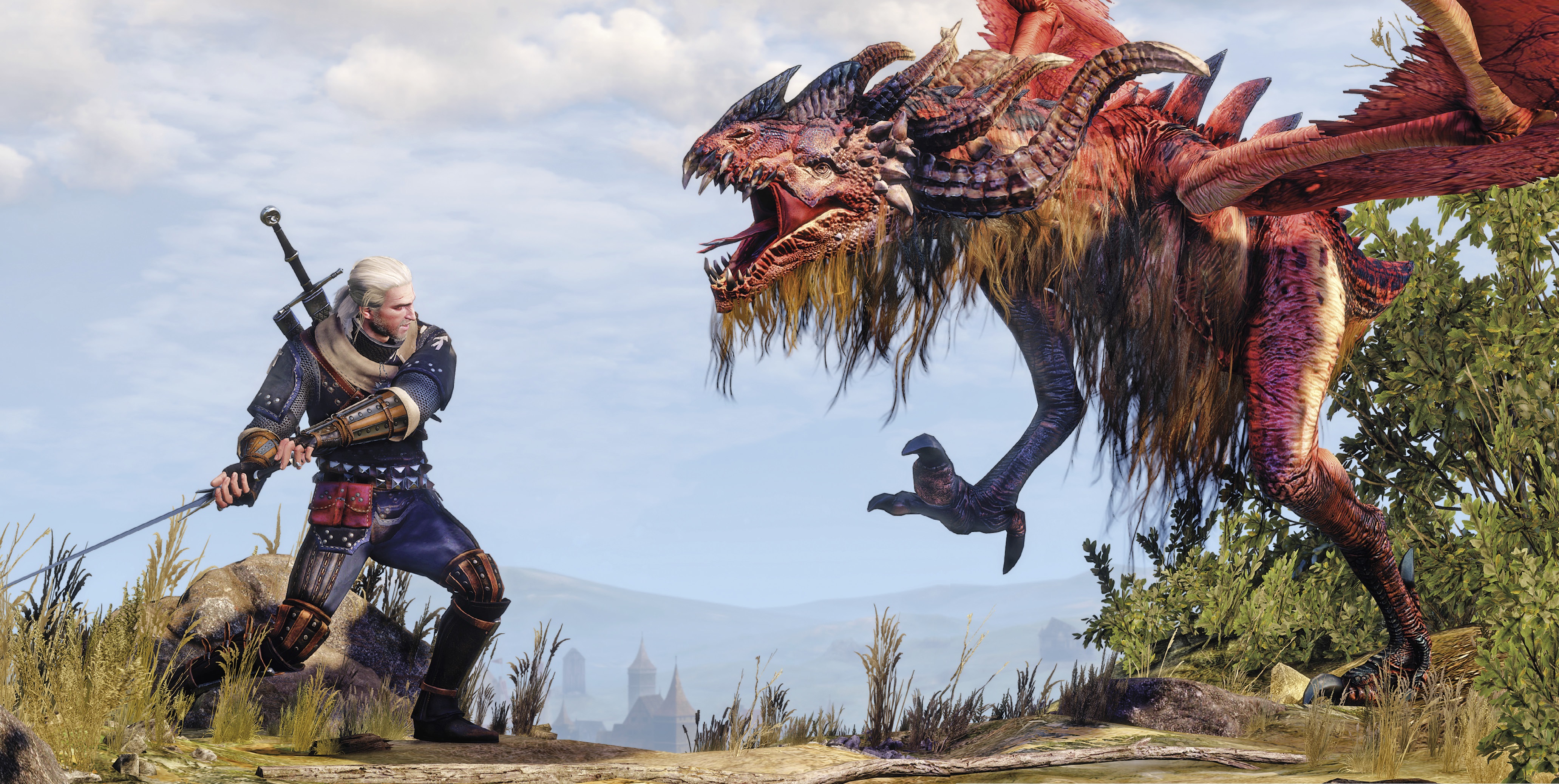
That realism informs much of Witcher 3's world design, which feels more like an untrammelled slice of barely tamed wilderness than an environment carved out by a design team. Whereas Bethesda create open worlds that are more like theme parks than real places, littered with caves, ruins and landmarks for players to lose themselves in, CD Projekt's first stab at the open world genre takes a lot of cues from Rockstar's Red Dead Redemption. Like that game, this is a world that seems to exist despite the player, not for them; it’s a world that strives for authenticity, one that’s meticulously detailed, but also curiously bereft of things to see and do, as a result. In terms of atmosphere, The Witcher’s open world, with its varied terrain, hilly expanses and dense woodlands, may trump Bethesda’s carefully curated chocolate boxes, but it never instilled in me the same desire to strike out and explore every corner of the map.
In most open-world games this would be a crippling blow, but Witcher 3’s main quest-line, not to mention its generous heaping of side missions, doesn't need pointless fetch quests and endless lists of collectibles to prop it up. The main missions alone will suck up a huge amount of your time, managing to spin epic sagas out of the most innocuous sounding objectives. Your main mission is to locate Ciri, errant Witcher and Geralt's adopted daughter. Problem is, Ciri never stays in one place for long, leading Geralt on an epic, cross country jaunt.

While the plot is short on real surprises, it is sharply written and, at times, manages to pack a real emotional punch. The writers at CD Projekt know this world inside out, and it shows in every barbed exchange and beautifully detailed bestiary entry. There’s a tendency for video game fantasy (and fantasy in general) to come across as a little po-faced, but The Witcher 3 balances out all its talk of magical races and mystical MacGuffins, with a generous helping of grit, grime and knowing humour.
The game's graphics, which are downright gorgeous even on my humbly-specced personal computer, bring Geralt's world to life beautifully, rendering everything from atmospheric forests and crumbling middens to labyrinthine underground ruins and bustling cities in painstaking detail. There is a tendency to overstuff environments, making it difficult to navigate certain areas --something exacerbated by the game's slightly clumsy feeling controls-- but you can't fault the ambition on display. Characters models are likewise impressive, their lopsided, asymmetrical mugs brimming with personality. While the animation powering these polygonal creations isn't quite as advanced, it's still surprisingly good, especially for a game of this scale.

And when it comes to scale, there are few games on the market that offer as much bang for your buck as The Witcher 3. By the time the final curtain came down, I had spent almost 100 hours in Geralt's shoes. Amazingly, despite racking up such a gargantuan playtime, I wasn't close to seeing everything the game has to offer; a quick look at the map shows that there is still plenty of uncharted territory to explore and questing to be done.
Speaking of quests, this is another area in which Witcher 3 excels, offering players lengthy, multi-faceted objectives, some of which take hours, if not days, to complete. Unlike most RPGs, which pad their length with a thankless procession of menial collect-em-ups, a lot of the optional side-content in The Witcher 3 is well worth exploring, offering some of the most memorable quest-lines in the game. Admittedly, your objectives usually boil down to going somewhere and either collecting or killing something, but each quest is enlivened by some impeccable writing, and the game's designers do a good job of mixing things up. Some quests will ask you to rely on your witcher senses, sifting through the environment for clues, while others will test your prowess in combat or send you beneath the waves for a little aquatic exploration.

Mechanically speaking, none of these activities feel as polished as they could be, with combat in particular feeling peculiarly stilted and unsatisfying. It's a definite improvement over the swordplay in the second game, but player movement is altogether too stiff and there's no real weight or impact behind Geralt's swings. This makes it feel like you're whacking at piñatas rather than living enemies. Thankfully, the enemies do put up a bit of a fight, and the focus on positioning, dodging, and careful tactics does occasionally make for some tense, exciting encounters. Sadly these encounters become less thrilling as the game wears on as it’s far too easy to become over-levelled, especially if you tackle plenty of side-quests.
This lack of polish creeps into other areas, too. Take your trusty steed Roach, for instance. You can call him up at any point with a click of a button, but his wonky path-finding usually sends him careening off in the opposite direction or trapped behind a fence or shrub. Then there’s the candles, the bloody candles! For some unfathomable reason someone at CD Projekt Red decided it would be a good idea to litter almost every surface in the game with these waxy irritants. I lost count of the amount of times I was trying to loot a chest or hit a switch, only to keep flicking an awkwardly placed candle on and off. I hear this has been patched (at least in the PC version) but it caused me innumerable headaches during my initial play-through.

For any other game these would be major issues, but when weighed against the huge, meticulously-curated amount of content The Witcher 3 serves up, they almost pale into insignificance. The individual parts may not be all that special, but taken as a whole, you’d be hard pressed to find another current-gen RPG on The Witcher 3’s level. Next time round, I hope the devs spend as much time fine-tuning their actual gameplay mechanics as they do their world-building and quest design, but despite the occasional stumble, this is one virtual odyssey I wouldn't hesitate to recommend.


